Security tasks and prioritization
Abstract
Security engineers are easily overwhelmed by hundreds of seemingly trivial issues. For example, it is hard to tell from the surface alone whether delayed patching for one class of exposure (e.g. a critical server-side framework issue such as CVE-2017-5638) should weigh above remediating a ubiquitous logging stack issue (e.g. CVE-2021-44228). Task prioritization is what separates an overwhelmed reviewer from a qualified security engineer.
A practical security engineer has a clear sense of the core value they must deliver and knows how to order work at both macro and micro levels.
For a security engineer, “security” comes before “engineering.” Protecting customers is the primary goal. From that perspective, the first qualification is knowing how to prioritize security tasks at macro and micro levels.
The core value of security is to protect
The core function of security defines how you prioritize. Security co-exists with threat—if there is no threat, there is no meaningful “security work” in the classical sense.
The NIST Computer Security Handbook (NIST Special Publication 800-12) defines computer security as:
The protection afforded to an automated information system in order to attain the applicable objectives of preserving the integrity, availability, and confidentiality of information system resources (including hardware, software, firmware, information/data, and telecommunications).
The priority of a security task is measured by how much protection it adds when completed. The more protection a job provides, the more value it creates—hence the higher priority.
Macro-level prioritization principles and practices
Macro prioritization focuses on long-term protection the security function can sustain. At this level, four essential activity families matter:
- Product / application security review (SDLC) — long-term prevention; eliminate or reduce risk before release.
- Incident response — handle immediate threats; mitigate present danger to the business and customers:
- Zero-day / emerging vulnerability alerts
- Build and maintain IR playbooks
- Execute the playbook when incidents occur
- Vulnerability management — manage exposed risk in what you already run:
- Residual risk acceptance and tracking
- Open-source dependency risk
- Supply-chain risk
- Security test and verification — find issues before they reach future customers:
- Security QA
- Security verification testing
- Penetration testing
- Security audit
A strong way to assign priority across these buckets is Eisenhower’s urgent/important principle. The chart below places macro-level work in that frame.
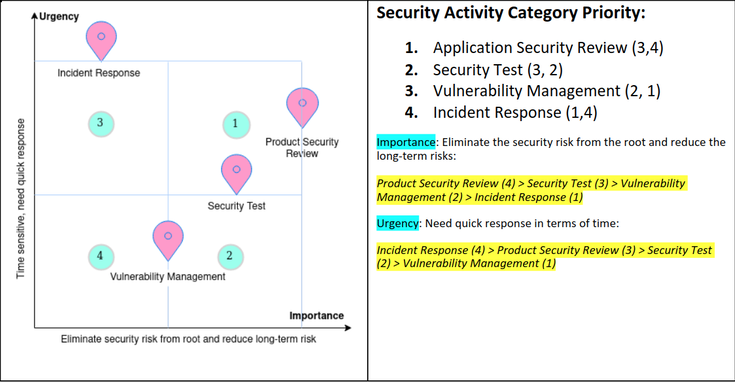
Asset: docs/assets/security-musings/security-task-prioritization.png (working copy of materials/security-task-prioritization.png).
Micro-level prioritization and metrics
After macro filtering, you still have many tasks inside one category. The same principle applies: more protection → higher priority. Because “protection” differs task by task, you need explicit metrics.
Product / application security reviews
- Data classification is the primary lever—systems that process confidential data generally outrank those limited to public data.
- Release status matters—a production service usually outranks an in-development prototype.
- A third tie-breaker can be dependency breadth or release date; both are defensible in practice.
Overall, the bias should be: protect critical data for existing customers before less essential exposure for hypothetical future customers, unless the business explicitly chooses otherwise.
Security testing and vulnerability management
A security bug bar (severity and exploitability rubric) usually drives prioritization here. Microsoft’s sample security bug bar is a rich reference (Microsoft may redirect to learn.microsoft.com). In practice, many teams anchor on CVSS 3.1 and customize which sub-metrics matter for their environment—see the CVSS 3.1 calculator.
Incident response
IR is time-sensitive. In general:
- Fresh, high-impact zero-days or equivalents take precedence over stale noise.
- Production outages or acute customer harm need immediate attention.
- Non-emergency work is often ordered by customer impact (for example scale of affected users times severity per case)—exact formulas matter less than a transparent, agreed rule.
Finally, playbooks should exist before the fire: document response patterns under your security architecture review process. It is too late to invent the emergency plan when the incident has already started.
Final words
Security risk is business risk. Prioritization of security work should track business priorities at macro and micro scales. That judgment is not only a manager’s job—it is part of what it means to be a professional security engineer, and it keeps the role anchored to the value only security can provide: protection.